Basics
What is a Japanese kitchen knife? Shapes, edges and steels explained
One Japanese knife exists to peel a daikon into a single sheet. Another is a thin stainless gyuto drawn on the lines of a Western chef's knife. Here is how the family splits, what the words on a listing mean, and which knife fits which cook.
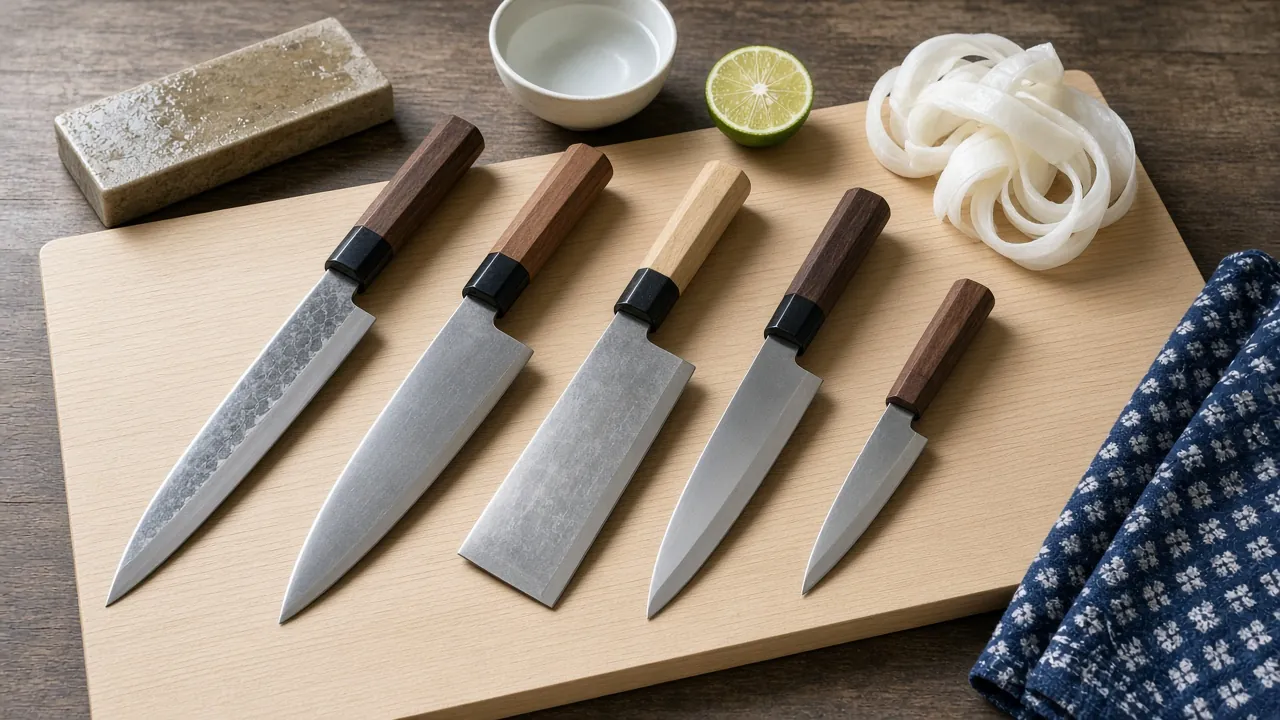
A knife for one sheet of daikon
There is a Japanese knife built to turn a daikon into one long, thin sheet. The cut is called katsuramuki, and the knife is the usuba, 薄刃, a straight-edged vegetable blade sharpened on one face only1. The name means "thin blade". Korin, the New York importer, says the square-tipped usuba comes from Kantō, around Tokyo, and the pointed kamagata usuba from Kansai, around Osaka4.
Hold an usuba next to a gyuto and the word "Japanese" starts to look too broad. One is a specialist tool with a flat back. The other is a Western chef's knife reworked in Japan. Both are Japanese kitchen knives. Most of the splits in this guide show up in the usuba, so it is a good place to start.
Two families, told apart by the blade
Japanese cooks sort kitchen knives into two families. Wa-bōchō, 和包丁, are traditional Japanese shapes. Most are single-bevel, usually with a plain wooden handle, and built for jobs such as sashimi, vegetables and fish. Yō-bōchō, 洋包丁, take their shapes from the West, the gyuto and the petty among them. Most are sharpened on both sides and do general work1.
The handles split the same way. A wa handle is straight and simple, usually wood, pushed onto a narrow tang. A yō handle is the Western kind, riveted on either side of the tang and shaped to fill the palm1. Handles no longer settle the question, though. Hocho Knife's Sakai Takayuki range lists gyuto with both kinds11. Look at the blade's shape to tell the families apart.
One sharpened face, or two
The usuba's flat back is the difference you will feel first.
A single-bevel knife, kataba, 片刃, is sharpened on one face. The other face is flat or slightly hollow1. Korin says the hollow back, the urasuki, gives a keener edge, easier resharpening and finer work, and ties the design to Japanese cooking's focus on clean cuts of fresh ingredients2. The edge also steers to one side. Single-bevel knives come in right- and left-handed versions, and Korin notes that one cannot be converted into the other21.
A double-bevel knife, ryōba, 両刃, is sharpened on both faces, like a European chef's knife. Korin calls it a stronger edge that suits any kitchen2. Many Japanese double-bevel knives are still lopsided on purpose. Makers often grind more of the bevel onto the front face, at ratios such as 70:30, to get closer to single-bevel sharpness2.
Seven shapes, and what each one is for
Korin notes that sushi chefs treat the yanagiba, deba and usuba as the core of a traditional set2. In Japanese homes, the popular all-rounder is the santoku1.
Gyuto, 牛刀
Japan's version of the Western chef's knife, used for meat, fish and vegetables1. Korin calls it extremely versatile and suited to Western cooking, with a name for a light, thin blade2.
Santoku, 三徳
A double-bevel all-rounder for meat, fish and vegetables, popular in Japanese homes1.
Nakiri, 菜切
A rectangular double-bevel vegetable knife, easy for home use1. Knifewear, a Canadian retailer, points out that its flat edge meets the board along its whole length, so a push-and-pull chop cuts all the way through3.
Petty
A small all-purpose knife for fine prep and fruit1.
Usuba, 薄刃
The katsuramuki knife from the opening, single-bevel and straight-edged, also used for fine julienne1.
Yanagiba, 柳刃
The long, slim single-bevel slicer for sashimi. It cuts in one long pulling stroke14.
Deba, 出刃
A thick, heavy single-bevel knife for breaking down fish1. Korin warns that it is not meant for chopping through large bones or for cleaver-style blows4.
Four more you will meet in shops
- Sujihiki, 筋引, is a long, narrow slicer for trimming sinew from large cuts of meat and slicing them1.
- Takohiki, 蛸引, is the square-tipped Kantō sashimi knife14.
- Kiritsuke, 切付, is a single-bevel knife with an angled, clipped tip that does the work of both yanagiba and usuba. People call it the head chef's knife, but a Tokyo retailer stresses that this is custom, not a rule. Double-bevel "kiritsuke gyuto" exist too1.
- Honesuki, 骨スキ, is a small, stiff, triangular knife for breaking down meat and poultry1.
Length, in sun and millimetres
Japanese shops often give blade length in sun, 寸, a traditional unit of about 3.03 cm. A 7-sun knife is about 21 cm1. Listings usually add the edge length, the hawatari, in millimetres, measured from the heel, the machi, to the tip1.
Words that describe the surface
Many product names describe the finish rather than the steel underneath.
- Kurouchi, 黒打, is the black forging scale, left on the blade as a rustic finish1.
- Tsuchime, 槌目, is a hammered, dimpled finish1.
- Nashiji, 梨地, is a fine matte texture named after pear skin1.
- Damascus or suminagashi means layers of different metals forged together to show a wood-grain pattern1. Korin notes that layered blades have caught on for their looks and their properties4.
- Kyōmen, 鏡面, is a mirror polish1.
Carbon, stainless, or both
Carbon steel
Traditional Japanese knives use carbon steel, usually called hagane, 鋼. It takes a very sharp edge and sharpens easily, and it rusts if left wet1. Korin tells owners to wipe carbon knives dry even mid-task, and says acidic food will discolour them without hurting performance5. The best-known names are the "paper" steels from Proterial, formerly Hitachi Metals. Shirogami, white, is the base. Aogami, blue, adds chromium and tungsten for wear resistance16.
Stainless steel
Stainless steel carries enough chromium to resist rust. It is easier to look after, and its cutting performance varies a lot from grade to grade1. You will see VG10, SG2/R2 and Ginsan on Japanese blades. Ginsan comes from the same steelmaker as Shirogami and Aogami, and turns up in traditional shapes because it sharpens fairly easily16. Korin still says to wash stainless knives after each use, because salt and acids wear away their protection5.
Clad blades
Many knives combine the two, with a hard carbon-steel core between softer stainless layers. Knifewear says this gets you most of carbon steel's sharpness with less fuss. The exposed edge can still rust and needs wiping dry3.
Kasumi, honyaki and the san-mai sandwich
- Kasumi, 霞, "mist", is hard steel forge-welded to soft iron. Polished, the iron looks hazy, hence the name14. Sakai's traditional knives are built this way, a soft iron body with a hard high-carbon edge, so the blade neither snaps nor bends and still cuts well7.
- Honyaki, 本焼, is one steel throughout. Clay goes on before quenching so only the edge gets fully hard1. Korin says honyaki holds an edge longest but is harder to sharpen and more likely to chip or crack if misused4. The Sakai maker Jikko says honyaki is unsuited to cutting hard foods8.
- Warikomi or san-mai is a steel core between two outer layers1.
Hardness on the Rockwell scale
Hardness is measured on the Rockwell C scale, HRC. A Tokyo retailer's glossary puts most Japanese knives at about HRC 58 to 64, with some very hard steels above that1. Korin's rule of thumb is that softer steel sharpens more easily but dulls sooner, and harder steel holds its edge longer but takes longer to sharpen2. Korin also says Japanese knives are generally lighter, thinner and harder than German ones. That suits precise work. It does not suit bones or frozen food2.
If you cut left-handed
Read the listing twice. A single-bevel knife is ground for one hand, so a left-handed cook needs one made left-handed1, and Korin says a right-handed blade cannot be converted2. Expect to pay more. Wada Shoten, an old Sakai wholesaler, charges extra for left-handed deba and sashimi knives14. Check the handle as well, because D-shaped Japanese handles are usually made for the right hand1. Many symmetrical double-bevel knives work in either hand1.
Matching the knife to the cook
- One knife for a Western kitchen. A double-bevel gyuto, or a santoku if you prefer a shorter blade21.
- A vegetable-heavy kitchen. Add a nakiri for push-and-pull chopping3.
- Little time for upkeep. Stainless, or stainless-clad carbon steel13.
- The keenest edge, and you will dry it as you go. Carbon steel such as Shirogami or Aogami5.
- Sashimi and whole fish. A single-bevel yanagiba and deba, ground for your hand2. For a first yanagiba, Korin suggests something forgiving, such as stain-resistant Ginsan or an easier-to-sharpen white steel2.
Some makers cover the whole range and some pick one lane. Masamoto in Tokyo sells Japanese-style and Western-style knives, including a molybdenum stainless line12. Sakai Takayuki makes Japanese, Western and Chinese shapes10. Kei Kobayashi in Seki works only in SG2, R2, powder stainless13. For the reasons behind the hype, read why Japanese knives are different. For where the shapes came from, read a short history. To decode the characters on the blade, see how to read a mei.
Whichever knife you buy, the Tsukiji shop Aritsugu gives the same instructions. Wash it by hand after use. Dry it well. Keep it out of the dishwasher. Before it goes into a drawer for a long stretch, give it a coat of oil. Aritsugu suggests camellia9.
Sources
Pages the editors read for this column, as fetched on 17 October 2026. Retailer and forum pages are secondary sources and are labelled as such in the text. Statements we could not confirm were left out. Links to Hocho Knife, a shop we have an affiliate relationship with, are marked sponsored (disclosure).
- Tenpos Chef's Knives (retailer, Tokyo/Osaka), Japanese knife glossary (Japanese). tenpos-chefsknives.com/ja/glossary-ja/
- Korin (retailer, New York), "Japanese Knife FAQ". korin.com/japanese-knife-faq
- Knifewear (retailer, Canada), Fujiwara Maboroshi Nakiri 150mm product page (shape and care notes). knifewear.com/products/fujiwara-maboroshi-nakiri-150mm
- Korin, "About Japanese Knives". korin.com/about-japanese-knives
- Korin, "Elements of Steel". korin.com/about-elements-of-steels
- Proterial, Yasugi Specialty Steel: GIN 3 data sheet and YSS grade list. proterial.com/e/yss/search/gin3.html
- Aoyama Square (Japan Traditional Crafts Center), 堺打刃物 (Sakai uchihamono). kougeihin.jp/craft/0710/
- Jikko (Sakai maker), "本焼包丁" (honyaki knives). jikko.jp/c/knowledge/detail/kouzou/honyaki-knife
- Aritsugu (Tsukiji, Tokyo), FAQ: care. aritsugu.jp/%E3%82%88%E3%81%8F%E3%81%82%E3%82%8B%E3%81%94%E8%B3%AA%E5%
- Aoki Hamono Seisakusho (maker of Sakai Takayuki), company profile. aoki-hamono.co.jp/company/
- Hocho Knife (retailer), Sakai Takayuki brand page (product list). hocho-knife.com/sakai-takayuki/
- Masamoto Sohonten, official site (product categories and news). masamoto-sohonten.co.jp/
- Hocho Knife (retailer), Kei Kobayashi brand page. hocho-knife.com/kei-kobayashi/
- Otonami, Wada Shoten (Sakai wholesaler) knife-making experience: options and pricing. otonami.jp/experiences/wada-shouten/
Written by The JKI Editors from the sources above, in our own words. Spotted an error? Email [email protected] and we will correct it.