History
A short history of Japanese kitchen knives
Sakai's knife fame began with tobacco, not fish. Japan's knife towns made swords, sickles and nails before they made kitchen knives, and the kitchen came last. Every date here is one we could source.
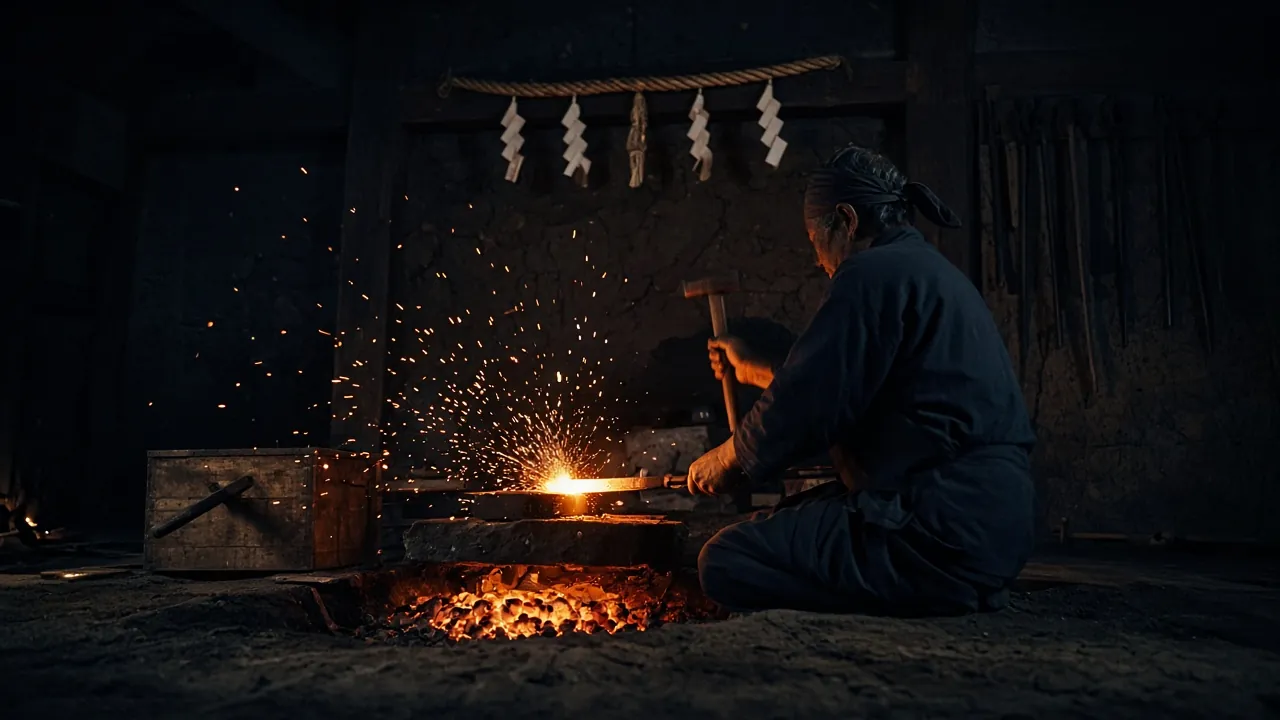
A stamp for tobacco knives
Sakai's knives made their name cutting tobacco. In the mid-16th century the Portuguese brought firearms and tobacco to Japan. In the second half of that century Sakai smiths began making tabako-bōchō, knives for shredding the leaf. The Tokugawa shogunate later gave Sakai a quality-certification stamp and a monopoly, and Sakai blades became known across Japan7. The tourism bureau gives the stamp's name, 堺極, Sakai kiwame6.
Hold on to that stamp. Four centuries later, the right to put a town's name on a blade is still protected by trademark registration, and the kitchen knife arrived somewhere in between.
Craft towns blend records with legend. Where a source says "it is said" or "by tradition", we say so too. Where two official sources disagree, we print both. Popular stories we could not trace to a reliable source are left out.
Swordsmiths who stayed
Korin, the New York importer, describes traditional Japanese kitchen knives as coming out of Japanese sword craftsmanship, with techniques handed down and refined over generations1. Several of today's knife towns tell their own story the same way.
Seki, in Gifu, dates its smithing to the Kamakura period. By tradition, a swordsmith named Motoshige came from Hōki province in 1229 and began forging there. The city's account lists what drew him. Seki had pine charcoal, good clay for hardening blades, clean water and river transport2. By the Muromachi period it had produced famous swordsmiths such as Magoroku Kanemoto and Kanesada, and at its peak it had more than 300 of them3.
Echizen, in Fukui, traces its knives to 1337. That year, it is said, the Kyoto swordsmith Chiyozuru Kuniyasu came looking for a good place to make swords, and made sickles for local farmers on the side. The national crafts centre adds that country smiths were already working there, so he had a trade to build on4.
Tosa, now Kōchi, had deep forests and an early need for logging tools. Sword-making techniques reached it in the Kamakura period5.
Sakai, before the tobacco
Sakai's story starts earlier still. Its tourism bureau says the groundwork was laid in the 5th century, when ironworkers making hoes and spades are thought to have settled there while the great Nintoku tomb was being built. Knife-making proper began in the 15th century, when knife-smiths descended from swordsmiths moved to Sakai from Kaga province, today's Ishikawa6. Tobacco came a century after that.
When did the kitchen knife arrive?
The answer depends on whose record you read. The national crafts centre says the deba appeared in the mid-Edo period, with other kitchen knives after it7. Osaka Prefecture says deba and other cooking knives were already being made in the early Edo period and had a national reputation8. Either way, the reputation was set by the end of the century. A 1797 edition of a book on Japan's famous products presents Sakai as an excellent knife-making area6.
Peace, guilds and new customers
The Edo period sent each town toward different blades.
- Seki. As demand for swords fell, many swordsmiths turned to kitchen knives, small knives and scissors, and Seki became a town of household cutlery3.
- Sakai. By the late Edo period it was also making flower and garden shears, and each group of specialists organised into trade guilds, kabu-nakama, which together formed the production area8.
- Echizen. Under the Fukui domain's protection, smiths formed guilds and sold blades nationwide, at first through lacquer-tappers who peddled knives as they travelled4.
- Tosa. A survey of the province in 1590 had already counted 399 smithies. The domain's Genna reforms of 1621 pushed forestry and new farmland, demand for farm and forestry blades grew, and output and quality rose sharply5.
- Sanjō, in Niigata. Smiths had made sickles and hoes since medieval times. Hand-made nails, at first an off-season job for farmers, led on to kitchen knives, planes, chisels and many other forged tools9.
1876, and a smith from Saitama
In 1876 the Meiji government's Haitōrei ordinance banned the carrying of swords, except by people in court dress and by soldiers and police in uniform10. Our sources do not measure what the ban did to knife-making, so we won't guess. The Seki record does say that pocket-knife production, which began in the Meiji era, set the town on the road to modern cutlery3.
Tokyo's Masamoto Sohonten dates its own story to these years. The company says its founder was born in 1845 into a family of country smiths, nokaji, in Musashi province, today's Saitama. He went to Osaka in 1862 to learn the secrets of honyaki smithing. He began making kitchen knives in 1866, made and sold the first honyaki kitchen knives in the Kantō region in 1874, opened his Tokyo shop in 1890 and registered the Masamoto trademark in 190311. A country smith's son learned honyaki in Osaka and built a Tokyo house on a registered name.
Belt hammers and brand houses
The 20th century brought machines into the forge. In Tosa, a locally developed belt hammer took over the heavy front-striker's job in the early Shōwa period. One smith recalls two men making about 42 forestry sickles a day before it, and one man making 100 after5.
Sakai's big houses took shape in the same century. Kawamura Hamono, maker of Sakai Kikumori, was founded in Sakai's old town in 192612. Aoki Hamono started as a Sakai-knife wholesaler in 1947, opened a Sakai office in 1963 and registered the Sakai Takayuki name as a trademark in 196413. The steel changed too. Alongside traditional carbon steels, high-carbon stainless steels such as Ginsan and VG10 won over professionals with their easy maintenance14.
The state began to recognise the regions by name. Under Japan's Traditional Crafts system, Echizen uchihamono was designated in 1979, the first cutlery region to be named4. Sakai uchihamono followed in 19827, Tosa uchihamono in 19985 and Echigo-Sanjō uchihamono in 20099.
Names worth protecting
The shogunate's stamp had a modern sequel. Osaka Prefecture records "Sakai uchihamono" as a regional collective trademark registered in October 20078. Seki registered 関の刃物, Seki no hamono, "Seki cutlery", as a regional collective trademark in 20083. Masamoto registered its own mark in 1903 and still warns buyers about imitations11. Read a place or a famous name on a blade as a claim, and check who is making it. Our column on how to read a mei shows how.
Sakai's old town today
The old system still has an address. Sakai's knife trade grew up in the old town, today's Sakai-ku, and the tourism bureau says the area is still full of workshops and wholesalers, many with shops attached. Some will engrave your name on a knife you buy there. The city also has a knife museum, CUT, on the history and the stages of production6.
From Sakai to more than 20 countries
The buyers now come from everywhere. Sakai's tourism bureau says the city's knives have drawn intense attention from cooks around the world, helped by the global boom in Japanese food6. Seki exports about a third of what it makes, according to its 2016 industry report3. Aoki Hamono says Sakai Takayuki has customers in more than 20 countries13. And smiths now reach buyers under their own names. Satoshi Nakagawa, a Sakai smith, says overseas buyers like knives that carry the maker's own name, and that some order after seeing his name on a blade15.
Timeline
| Year | Event |
|---|---|
| 5th c. | Ironworkers thought to settle in Sakai during the Nintoku tomb's construction6 |
| 1229 | By tradition, swordsmith Motoshige begins forging in Seki2 |
| 1337 | Swordsmith Chiyozuru Kuniyasu said to arrive in Echizen4 |
| 15th c. | Knife-smiths of swordsmith descent move to Sakai from Kaga6 |
| Late 16th c. | Sakai begins making tobacco knives7 |
| 1590 | Tosa survey records 399 smithies5 |
| 1621 | Tosa domain's Genna reforms raise demand for blades5 |
| 1797 | Book of famous products presents Sakai as a top knife area6 |
| 1874 | Masamoto: first honyaki kitchen knives in Kantō11 |
| 1876 | Haitōrei bans carrying swords10 |
| 1979–2009 | Echizen, Sakai, Tosa and Sanjō designated Traditional Crafts4759 |
See how these traditions shape today's knives in why Japanese knives are different, learn the shapes in what a Japanese kitchen knife is, or browse makers by town on our regions page.
Five forges in twenty years
Nakagawa, the smith who opened his own Sakai forge in 2021, has a forecast too. He says it is predicted that only about five Sakai forging workshops will remain in 20 years, and he openly invites people who want to enter the trade15. Tosa's smiths face the same ageing and succession problem5. Four centuries after the shogunate stamped Sakai's tobacco knives, one of its smiths is asking newcomers to take up the hammer.
Sources
Pages the editors read for this column, as fetched on 17 October 2026. Retailer and forum pages are secondary sources and are labelled as such in the text. Statements we could not confirm were left out. Links to Hocho Knife, a shop we have an affiliate relationship with, are marked sponsored (disclosure).
- Korin (retailer, New York), "About Japanese Knives". korin.com/about-japanese-knives
- Seki City official site, "刀祖元重の碑" (monument to the swordsmith Motoshige). city.seki.lg.jp/kanko/0000001533.html
- Seki City, "平成27年度 関市の工業" (Seki industry report, March 2016), introduction. city.seki.lg.jp/cmsfiles/contents/0000004/4761/kogyo_h27.pdf
- Aoyama Square (Japan Traditional Crafts Center), 越前打刃物 (Echizen uchihamono). kougeihin.jp/craft/0709/
- Aoyama Square, 土佐打刃物 (Tosa uchihamono). kougeihin.jp/craft/0713/
- Sakai Tourist Guide (Sakai City Tourism Bureau), "世界が注目する「堺の刃物」の魅力". sakai-tcb.or.jp/feature/detail/18
- Aoyama Square, 堺打刃物 (Sakai uchihamono). kougeihin.jp/craft/0710/
- Osaka Prefectural Government, 堺打刃物 (Sakai cutlery, traditional craft page). pref.osaka.lg.jp/o110070/mono/dento/dento16.html
- Aoyama Square, 越後三条打刃物 (Echigo-Sanjō uchihamono). kougeihin.jp/craft/0706/
- Kotobank (Japanese reference dictionaries), 廃刀令 (Haitōrei). kotobank.jp/word/%E5%BB%83%E5%88%80%E4%BB%A4-115157
- Masamoto Sohonten, company history. masamoto-sohonten.co.jp/history.html
- Kawamura Hamono (Sakai Kikumori), company profile. choyo.kikumori.co.jp/ja/profile/
- Aoki Hamono Seisakusho, company profile and history. aoki-hamono.co.jp/company/
- Korin, "Elements of Steel". korin.com/about-elements-of-steels
- Sakai City open-factory guide: Nakagawa Uchihamono. sakai-openfactory.jp/nakagawa-kajiya/
Written by The JKI Editors from the sources above, in our own words. Spotted an error? Email [email protected] and we will correct it.